

Key Takeaways
-
The BANT framework helps sales teams qualify leads by focusing on budget, authority, need, and timeline. This streamlines the process for better efficiency.
-
By understanding each lead’s situation and adapting BANT questions to it, we can tease out valuable information and convert more leads.
-
Augmenting the BANT process with technology, such as CRMs and data analytics, improves its precision and monitoring.
-
Mixing BANT with other qualification models or hybrid approaches can tackle complex sales scenarios and diverse market demands.
-
BRP leads to qualifying with a heart, not just a brain.
-
Tracking metrics and feedback loops facilitate ongoing optimization and success.
BANT lead qualification framework explained illustrates an effective way to sort sales leads by Budget, Authority, Need and Timeline. BANT aids sales teams in identifying which leads deserve additional attention.
Teams use BANT to eliminate wasted effort and increase conversion rates. With obvious criteria, BANT provides a method of determining if a lead is appropriate.
The following sections dissect each component and provide advice for practical application.
What is BANT?
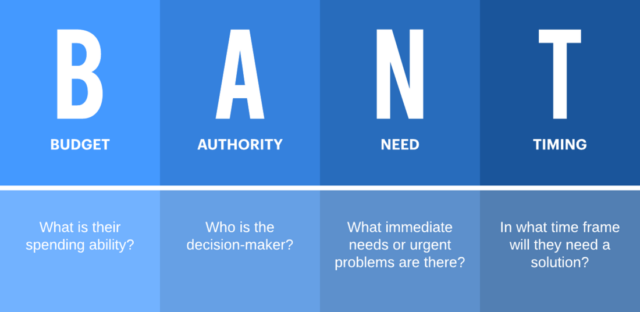
What is BANT? BANT is a sales lead qualification framework developed in the 1950s to assist sales teams in evaluating and prioritizing leads. It’s an acronym for Budget, Authority, Need, and Timeline. Each component acts as a filter to determine whether a lead is prepared and capable of purchasing.
BANT is methodical and seller-oriented, concerned with whether a prospect is suitable for a particular offering. Sales teams leverage BANT to rapidly qualify leads, prioritize resources effectively, and increase conversion rates. Many teams modify the traditional BANT formula or supplement it with alternatives like ANUM or MEDDIC, but BANT continues to be a staple in sales organizations worldwide.
1. Budget
Budget is about determining if the lead can pay for your product. Sales teams have to get direct, ask questions, and listen for cues that the budget aligns with the product or service price. For instance, “What’s the budget for this project?” or “Have you allocated funds for this solution?
Not everyone will have the same spending power, so knowing the ceiling early prevents wasted effort. If a lead’s budget is too low, then teams can either recommend alternatives or leave it to more suitable prospects. Budget deals don’t close if they’re not aligned with the budget, even the best solutions.
2. Authority
Authority is about determining who has the final say in the purchase. Many salespeople talk to someone who’s just researching, not the real buyer. Knowing who the purchasing power is saves time and accelerates sales.
Good tactics are things like, ‘Who else is involved in the decision process?’ or, ‘Will you be the one to sign off on this?’ Skipping this step results in cul-de-sacs and squandered energy. Sales teams that have access to actual decision-makers see more deals close and less stalling.
3. Need
Need is about determining whether there’s a genuine issue that your solution can tackle. Sales reps should query ‘What are you struggling with today?’ or ‘What would success look like for your group?’.
This uncovers pain and aligns your offering with what matters most to the buyer. Need analysis not only hones your sales pitch, it inspires trust. Solutions that are matched to real business problems have a much better chance.
4. Timeline
Timeline refers to when the lead plans to make a decision or buy. Some buyers want a solution quick, others might need months. Sales teams query, “When are you looking to begin implementing this product?” or “Is there a timeline for this initiative?
This data helps sales teams prioritize leads and control the pipeline. Clear timelines set expectations, reduce uncertainty, and keep deals from stalling.
BANT’s Evolution
BANT’s origins go back much further. This lead qualification framework was first employed in the 50s. It was designed to assist sales groups grind through leads more quickly by using a list of Budget, Authority, Need, and Time. Over the years, the sales world evolved. BANT has evolved as well, but it continues to appear in many sales playbooks. At its heart, the concept remains the same. It simplifies the task of identifying true buyers in a crowd of leads.
Its Origin
BANT began as a simple on-the-fly framework for sales teams to triage leads. At the dawn of modern sales, sales teams needed a way to determine who was worth their time. BANT’s four points — Budget, Authority, Need, Timeline — gave sales reps a way to validate if a lead even had a chance of buying. If a prospect fit, reps would keep going. If not, they’d move on.
BANT worked because it reduced sales to fundamentals. They no longer had to wonder if a prospect could buy. For instance, a software company in the ‘60s might inquire, “Does this prospect have the budget?” and “Can the person I’m talking to decide?” These steps clarified the process and minimized wasted effort.
What made BANT stick was its grounding in real-world problems. Sales reps everywhere faced the same headache: chasing leads that never closed. BANT was built to combat that, and the recipe remains potent. Even as sales have gotten harder, the framework’s goal to preserve time and effort still resonates.
Its Adaptation
Sales has evolved significantly since BANT’s inception. Buyers today research products, compare numerous alternatives, and demand immediate responses. BANT has been forced to expand. BANT as it exists today: Most teams now use digital tools to track leads. Data analytics can identify patterns in lead progression through the funnel.
Others introduce new questions to address things BANT overlooked, such as what issues the buyer is dealing with or how soon they require a solution. Industries have taken BANT and modified it to their requirements. In tech, for example, products are expensive and the decisions take months. BANT’s simple checklist can be adapted.
Some teams tack on additional steps, like inquiring about a prospect’s pain. Others mix BANT with newer frameworks such as GPCTBA/CI, which explores goals and challenges in greater depth. As sales cycles lengthen and decision making becomes more complicated, BANT provides a foundation to grow from.
It doesn’t always suffice on its own, but it’s adaptable. Teams can append steps or integrate it with other tools. In B2B sales, it aids in distinguishing between ready to buy and not. Other teams use BANT as an initial filter and then supplement it with more nuanced frameworks to explore the buyer’s actual pain.
Modern Application
Today, BANT is anything but a ‘checklist’. It thrives as a living process molded by technology, judicious strategy, and empathy for each lead’s circumstances. Companies now employ visual CRM systems that nudge, record, and rate each step, ensuring that not a piece of BANT is missed.
The technology allows sales teams to automate analysis, reminders, and follow-ups, saving hours every week and giving reps room to breathe and focus on actual conversations. For most companies, deciding what a ‘qualified’ lead means across BANT is critical. This defines your bullseye and gives everyone a shared vocabulary to identify your best leads.
Flexible Questions
The most valuable results come from customized BANT questions. Hard scripts frequently miss important nuances. Open-ended questions like “How do you decide on budget for projects like this?” or “Who else should be involved in this discussion?” encourage leads to share more, allowing sales teams to discover problems and needs that canned yes or no questions overlook.
Adapting the questions to the lead’s industry and role is essential. For example, a healthcare provider might require questions about regulatory timelines, while a retail business might focus more on seasonal budgets. Sales teams can uncover hidden pain points or priorities by asking “What challenges are you hoping to fix with this purchase?
This maintains the dialogue organically and fosters confidence. Flexible questions help you understand a lead not only if they qualify, but why.
Common Pitfalls
Too many teams coast by clinging to BANT as a hard checklist. Such an approach can cause teams to miss genuine opportunities or alienate leads with boilerplate questions. Another pitfall is assuming authority or budget without confirming, or missing changing priorities when leads move through the pipeline.
Training and coaching assist teams in understanding when to adhere to the framework and when to deviate.
-
Pose open questions each time, not just for the structure.
-
Verify each answer—don’t rely on assumptions or old data.
-
Keep learning—ongoing coaching helps teams avoid stale routines.
-
Leverage CRM tools to automatically flag incomplete or outdated information and prompt updates.
Commercial teams that adapt, listen, and keep skills sharp experience higher conversion rates and fewer missed opportunities.
Technology Integration
Modern sales teams depend on CRMs to score BANT, change lead status and record every touch. Visual dashboards help reps identify leads lacking crucial information and automate follow-up task assignments. Workflow and status columns help teams through qualification with conditional formatting that flags hot tasks or top prospects.
Automation saves time by lead scoring and nudging teams to follow up on critical information. AI lead scoring systems can convert the perfect BANT profile into an operational one, sifting through the information to identify the most valuable leads.
Data analytics then provide teams with visibility into trends, enabling them to tweak strategy and focus where it matters. With all four BANT boxes checked, conversion rates increase and sales teams can accelerate, liberating every opportunity to the max.
Beyond BANT
BANT has defined lead qualification for decades. The buying environment has evolved. Buyers now have more options, deeper product knowledge, and flexible budgets. Structured frameworks overlook real possibilities. Embracing the new realities involves trying different approaches and mixing the best.
Alternative Frameworks
Sales teams today have moved on to CHAMP, MEDDIC and FAINT. CHAMP (Challenges, Authority, Money, Prioritization) looks at problems first, helping teams identify the underlying pain, which is helpful when buyers are still scoping out what they need. MEDDIC (Metrics, Economic Buyer, Decision Criteria, Decision Process, Identify Pain, Champion) fits complex B2B, drilling into expected ROI and outlining the decision process.
FAINT (Funds, Authority, Interest, Need, Timing) extends beyond BANT, seeking available funds rather than rigid budgets and accommodating prospects who have ambiguous buying timelines.
|
Framework |
Strengths |
Weaknesses |
|---|---|---|
|
CHAMP |
Focuses on buyer’s main challenge, flexible |
May miss urgency, less focus on budget |
|
MEDDIC |
In-depth, maps stakeholders, quantifies pain |
Complex, needs detailed research |
|
FAINT |
Flexible on budgets, fits early-stage leads |
Can qualify unfit leads, less structured |
In territories with distributed decision-making among many stakeholders, MEDDIC’s more granular mapping assists. For SaaS startups chasing small businesses with quickly evolving needs, FAINT’s versatility shines. In tech sales, CHAMP gets your reps to really know what the core problem is and why a solution is important at this moment.
Interspersing frameworks can assist. A lot of teams begin with BANT’s fundamentals, then apply MEDDIC measures to identify group decision makers or CHAMP to get at the buyer’s underlying pain. This layered approach covers more ground, helping teams adapt as the buyer’s journey unfolds.
Hybrid Models
Hybrid models combine different frameworks, allowing teams to adapt to evolving sales cycles. By mixing and matching components, such as BANT’s budget insight with MEDDIC’s pain quantification, sales teams can tailor their methodology to each deal. This is key when buying groups consist of six or more stakeholders, each with their own agenda.
A hybrid model can accelerate sales. Teams can identify urgency at an early stage while contextualizing anticipated ROI, enabling them to prioritize the right leads. For instance, a global software provider might use BANT to weed out leads, then shift to MEDDIC to map decision-makers and CHAMP to define the primary challenge. Each step is formed by what the prospect requires most at that step.
No one size fits all business framework. A hybrid approach allows teams to customize their process, striking the optimal equilibrium between velocity, depth, and adaptability. This comes in handy, especially in verticals where sales cycles keep getting shorter and the buying committee is getting bigger. Relying on any one method risks overlooking leads that don’t conform to a single mold.
The Human Element
The BANT lead qualification framework sets a standard for sorting leads. It’s the people and their interactions that breathe life into it. Logic-based approaches fail to acknowledge that purchasing decisions are seldom made by a single individual. Every lead has different requirements, issues, and reasons.
Trust and rapport aren’t simply part of the sales process; they are the basis for long-term partnerships. According to the research, having the right people in meetings increases the likelihood of a follow-up by 36 percent, emphasizing the need for a human touch. Sales organizations that care about the human behind the lead, not just the checklist, experience stronger outcomes and relationships.
Conversation
Meaningful conversations are the heart of BANT qualification. They step out of prepared questions and into conversation. When salespeople inquire intelligently and listen carefully, they discover pain points and desires that a form would overlook.
Communication is not what you say, it’s how you say it. Tone, timing, and clarity all count. A conversational guide helps sales teams build relationships, so it doesn’t feel like an interrogation and feels like a real exchange. Active listening allows prospects to talk more about their circumstances, which means that everyone walks away with a better understanding.
Open dialogue fosters trust. Allowing leads to ramble on about their goals and challenges usually uncovers specifics that define the sales strategy. That establishes a connection that goes beyond a single transaction and creates the foundation for enduring allegiance.
By taking the time to listen and respond thoughtfully, you transform a sales call into the beginnings of a partnership.
Empathy
Empathy is a central component of effective lead qualification. It’s more than what the lead wants; it’s why they want it. Empathy is about tuning in to emotion and to what’s behind the decision.
Rather than drive a checklist, sales teams can query, “What obstacles are you encountering at the moment?” or “How does this solution fit your team’s objectives?” These questions demonstrate consideration and respect for the lead’s viewpoint, which builds trust.
An empathy-driven sales call looks and feels different. It’s not about checking off boxes; it’s about cracking the code to an actual problem. Leads open up when they feel heard, not judged. This tends to result in superior intelligence and therefore superior solutions.
Putting the human element, empathy, before the interrogation not only fosters trust but delivers better results.
Context
Context is key to getting the full picture of a lead’s needs and priorities. Each industry has its trends and struggles, and those things help define buyer preferences. Context can involve market shifts, company changes, or even recent news that could influence the lead’s decisions.
Sales teams can get ready by researching industry reports or tracking company news before contacting. Understanding the context helps customize the pitch to what the buyer cares about most.
For instance, a new healthcare rule could turn a lead’s priorities upside down overnight. Acknowledging this and shifting the dialog demonstrates to the lead that the salesperson is not only knowledgeable but engaged.
A human-centric approach, contextualized, assists sales teams in navigating complicated buying journeys and cultivating deeper, more resonant connections.
Measuring Success
BANT lead qualification – Measuring success means looking at what works and what needs to be changed. It’s not just about lead count. It’s about measuring the right things, defining success, and iterating on feedback. This helps teams understand if prospects are being qualified in a way that results in growth.
A lead who meets three out of four BANT qualifiers is typically a safe bet. All four should convert at much higher rates. Reviewing previous deals, which companies renewed or exhibited strong returns, for example, enables teams to identify the markers of success. With metrics, teams can verify whether their sales cycle corresponds to the buyer’s timeline and whether their follow-up is effective.
Key Metrics
|
KPI |
Description |
Example |
|---|---|---|
|
Conversion Rate |
% of qualified leads that become customers |
30% of leads meeting all BANT criteria close |
|
Sales Cycle Length |
Time taken from first contact to closed deal |
Average: 45 days |
|
Lead Scoring Accuracy |
How well scores predict actual sales outcomes |
85% of high-scoring leads close |
|
Revenue Growth |
Increase in sales attributed to BANT-qualified leads |
€10,000 monthly from BANT leads |
|
Opportunity Win Rate |
% of BANT opportunities that end in a sale |
60% of four-criteria leads win |
Conversion rates indicate BANT’s effectiveness. If 60% of those who pass all the filters close, your process is rigorous. Lead scoring on BANT answers can help sales teams spend time wisely. For instance, if a lead’s timeline aligns with our 45-day average sales cycle, that is a great indicator.
For example, goals that have some measurable component are key. A team might target that 80% of new opportunities satisfy at least three BANT criteria, or that 90% of qualified leads align with the average cycle time. Tying these goals to sales targets makes them more actionable.
In terms of measuring success, aligning your metrics with your sales goals keeps everyone going in the same direction. If revenue growth from BANT-qualified leads is increasing, the team knows it is targeting the right prospects.

Feedback Loops
Feedback loops keep the BANT process honed. When a deal is won or lost, the team debriefs on what worked and what didn’t. Discussing with sales reps helps you understand why some leads converted or dropped out. Perhaps a lead appeared robust but had a hidden budget problem.
That feedback assists in adjusting qualification processes. Sales teams can leverage regular meetings, brief surveys, or CRM notes to gather feedback. For instance, teams might discover that leads with ambiguous decision authority tend to get stuck, so they switch how they inquire about decision makers.
You need to keep learning. They look at data and feedback, together with their teams, to identify patterns. This could involve refreshing questions, automating portions of the flow or changing how leads are scored.
Over time, these incremental shifts accumulate into a system that becomes increasingly efficient at sourcing the right leads.
Conclusion
BANT provides a straightforward, consistent method to quickly qualify leads. It assists teams in identifying genuine buyers and reduces time on feeble leads. Sales reps use it to talk about the right things and get to the real needs. Today, BANT thrives with a personal touch, not as a cookie cutter instrument. Most teams confuse it with other methods for addressing actual buyer concerns. Nice checklists are helpful, but straight talk establishes credibility. Data tells you what works and what to pivot. For more insight, test BANT with your own flavor and monitor results. For additional lead work advice or inquiries, contact or explore additional tutorials.
Frequently Asked Questions
What does BANT stand for in lead qualification?
BANT stands for Budget, Authority, Need, and Timeline. It assists sales teams in determining whether a lead is suitable for their offering.
How has the BANT framework evolved over time?
BANT has evolved to keep pace with contemporary purchasing habits. Today it’s more flexible and about building relationships, not just checking boxes.
Why is BANT still relevant in modern sales?
BANT provides an easy way to qualify leads and deploy sales resources effectively. It saves time by quickly identifying your most promising prospects.
What are some limitations of the BANT framework?
BANT can be paper thin when used on its own. It can overlook leads whose need or authority shifts in the course of the purchase.
How can companies measure the success of BANT?
Success can be measured by conversion rates, sales cycle length, and the quality of leads pushed through your sales funnel.
How does BANT compare to other lead qualification frameworks?
BANT is straightforward. Other frameworks, such as MEDDIC or CHAMP, can be more insightful but more complicated.
Can BANT be adapted for global sales teams?
No, BANT is adaptable and can be leveraged by sales teams across the globe. It requires minor tweaking for local markets and business cultures.